It’s 8:15 pm, and a patient’s on your website trying to work out if they need a referral before their appointment. There’s no one to ask. They close the tab and book with a clinic down the road instead.
Jump Ahead to...
ToggleThis is exactly why so many Australian practices are looking at AI chatbots to help close the gap. However, one burning question remains:
Does bolting a chatbot onto your website actually improve how patients interact with your practice, or is it another tech that delays the whole process?
The short answer: medical chatbots improve patient interaction, but only when they’re built for a few specific tasks. Once things get complicated, a human should still be the fallback. Peer-reviewed research backs this up. If you want to learn more, we’ll discuss the value AI chatbots bring to medical practices in Australia.
Key Takeaways:
- A systematic review of 29 studies found that hybrid medical chatbots reduced hospital re-admissions by up to 25% and reduced consultation wait times by around 15%, primarily through improved triage and follow-up.
- The same research found that chatbots increased patient interaction rates by 30%, which, for a clinic, means fewer missed touch points between visits.
- In a controlled pilot trial, patients using an AI chatbot saw their depression scores drop from 5.13 to 3.68 and anxiety scores drop from 4.74 to 3.4.
- Under AHPRA guidance, you are clinically responsible for anything your chatbot tells a patient.
What Counts as a Medical AI Chatbot?
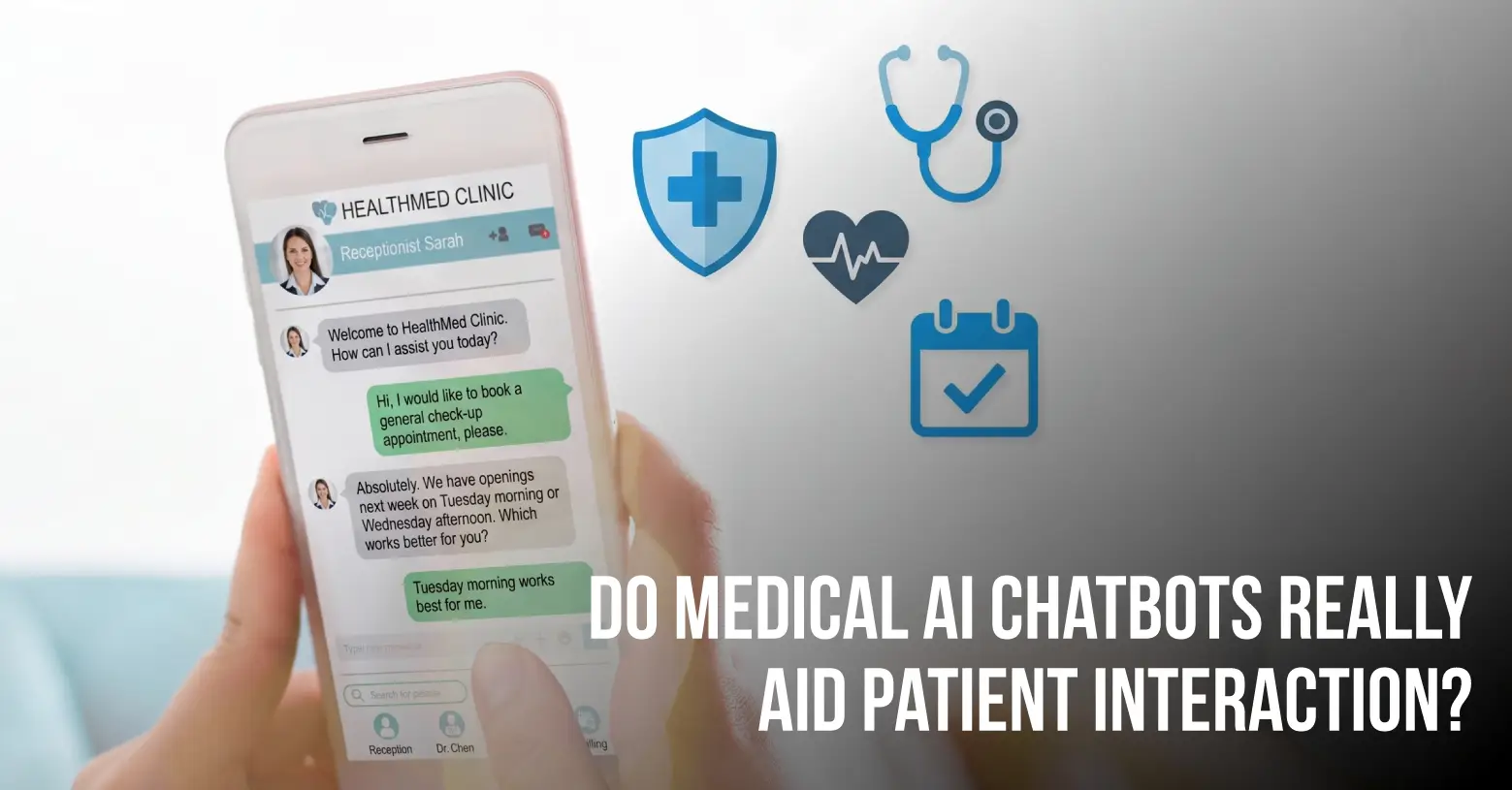
A medical AI chatbot is software that uses natural language processing to converse with a patient in either text or voice. Then, based on the patient’s needs, they:
- Answer a question.
- Book an appointment.
- Flag a symptom for follow-up.
These are among a few actions AI chatbots can do.
Simply put, if a patient can type a question and get a conversational and relevant response without a human typing it, that’s a chatbot.
However, “AI chatbot” gets used as a general term. A booking bot that lets patients reschedule an appointment at 11 pm is a completely different tool.
For clinics, the distinction between an AI chatbot and a booking or FAQ bot is crucial. A booking or FAQ bot handles admin tasks, such as answering questions about opening hours and appointment times. These tasks don’t require the complexity of an AI chatbot.
Do AI Chatbots Actually Improve Patient Interaction?
The short answer is yes, though the “how much” depends heavily on what the chatbot is doing and who’s using it. There’s even data that backs this claim up and shows that…
AI Chatbots Help Reduce Hospital Re-admission
A 2025 systematic review in Frontiers in Public Health, which screened 116 studies down to 29 that met its criteria, found that hybrid AI chatbots (AI paired with human oversight) reduced hospital re-admissions by up to 25% for chronic conditions such as diabetes and hypertension.
AI Chatbots Can Catch Health Problems Before They Get Worse
The same review above found chatbots increased patient interactions by 30%. This means more patients get a check-in message between appointments. It also found that consultation wait times dropped by roughly 15% because routine questions are sorted ahead of time.
AI Chatbots Aid in Mental Health Support
Mental health support shows some of the more striking results. A pilot randomised controlled trial from the University of Hong Kong tracked depression and anxiety scores before and after each AI chatbot intervention.
The chatbot group’s average depression score fell from 5.13 to 3.68, a statistically significant drop (P=.008), while anxiety scores dropped from 4.74 to 3.4 (P=.005).
This might be a small trial, and it measured self-reported symptoms rather than clinical diagnoses, but it’s a genuine head-to-head comparison against a human-staffed alternative.
The pattern across the research is consistent: chatbots perform best on structured, repeatable tasks, not open-ended clinical judgement.
Where Do AI Chatbots Fail?
The same review that found those gains was just as clear about the limits.
Patients Often Don’t Trust AI Chatbots
Patients hesitate to rely on a chatbot for medical matters when they’re unsure how their data is stored or whether the advice is accurate. That hesitation doesn’t disappear just because the technology improves.
They Lack Empathy (Only Humans Have This)
AI-only systems struggle with the emotional cues humans can recognise at a glance. This is especially true in mental health support and end-of-life conversations, where a scripted response can sound tone-deaf.
They Can’t Work On Complex and Rare Cases
AI chatbots are trained to spot common patterns, so anything unusual risks a poor or misleading answer. Language and culture make this worse too. A chatbot built for one group of patients often struggles with a patient speaking a second language. They could also be describing symptoms in their own way, which matters a lot in a country as multicultural as Australia.
Are Medical AI Chatbots Legal in an Australian Practice?
Yes, but only if you follow the rules closely. Healthcare is one of the most tightly regulated industries in Australia, which means chatbots are under heavy scrutiny as well. Here’s what you need to know:
Chatbot Mistakes Are Your Responsibility
AHPRA’s position is simple: no matter what technology you use, you’re still responsible for the care your patients get. That includes anything your chatbot says. If it gets a patient’s symptoms or medication info wrong, that’s on you, not the software company.
To stay on the right side of this, AHPRA expects you to:
- Tell patients when they’re talking to AI.
- Understand the tool you’re using, not just trust what the vendor tells you.
- Get informed consent before the chatbot collects any personal information.
Does Your Chatbot Need TGA Approval?
It depends on what the chatbot does. The Therapeutic Goods Administration (TGA) treats software as a medical device when it’s meant to diagnose, monitor, or treat a condition.
- A booking bot or FAQ assistant generally DOESN’T NEED approval.
- A symptom-checker that assesses urgency or suggests a diagnosis is very likely to do so.
Don’t Forget Patient Data Rules
Any chatbot collecting patient information also needs to comply with the Privacy Act 1988 and its 13 Australian Privacy Principles, which govern how that data is collected, stored, and used.
Get your website and chatbot set up properly from the start, and none of this needs to be a headache. That’s exactly what our team does at VMA Medical. We build clinic websites with booking and chatbot integrations designed around AHPRA and TGA requirements from day one.
If you’re weighing up whether a chatbot fits your practice, we can talk you through what a properly scoped setup actually looks like.
What Makes a Medical Chatbot Actually Useful for Patients?
The research points to a fairly consistent list of what separates a chatbot patients actually use from one they abandon after one bad experience:
- Keep the scope small. Bookings, FAQs, and basic triage prompts. Leave the diagnosis to a doctor.
- Disclose that it’s AI, clearly. Patients should never have to guess whether they’re talking to a bot or an employee.
- Build in an easy human hand-off. One click or a specific prompt should connect a patient to your reception team.
- Write in plain language. Skip the medical jargon. If a patient wouldn’t say it that way, the chatbot shouldn’t either.
- Integrate it with your booking system. A chatbot that can’t see real appointment availability just creates more admin, not less.
Frequently Asked Questions
Can an AI chatbot diagnose a patient in Australia?
Generally, no, not without TGA approval as a medical device. A chatbot intended to diagnose, monitor, or suggest treatment for a condition falls under TGA regulation, and using an unapproved tool for that purpose isn’t just risky; it’s against the rules.
Do I need patient consent to use a chatbot on my clinic website?
Yes. AHPRA guidance requires informed consent before an AI tool processes a patient’s personal information, and any data the chatbot collects needs to comply with the Privacy Act 1988. Update your privacy policy to reflect it.
Will an AI chatbot replace my reception staff?
Not based on the evidence. Chatbots handle repetitive, structured tasks well, like bookings and FAQs, but the research consistently shows they fall short on empathy and complex judgement calls. The clinics getting the best results use chatbots to support reception staff, not replace them.
How do I know if a chatbot needs TGA approval?
It comes down to intent. If it’s helping with bookings, opening hours, or general FAQs, it likely sits outside TGA regulation. If it assesses symptoms, suggests a diagnosis, or recommends treatment, check the TGA’s guidance or contact them directly before deploying it.
The Bottom Line
Medical AI chatbots do improve patient interaction, backed by real trial data, not just vendor promises. But that only holds true when the chatbot has a clear job, a human backup, and a setup that meets AHPRA and TGA requirements.
Want to see if your practice can benefit from having an AI chatbot? Get in touch with us, and we’ll walk you through what a properly scoped, compliant chatbot could look like for your website.